Research areas

Ultrafast Photothermal
Materials Engineering

Intense-pulsed-light processing for metastable phase formation, catalyst redistribution, heterostructure synthesis, and chemical-sensor surface engineering.

4 publishedFirst-Author Papers
1Manuscript in Revision
15Collaborative Papers

Research objective

Why Ultrafast Thermal Processing?

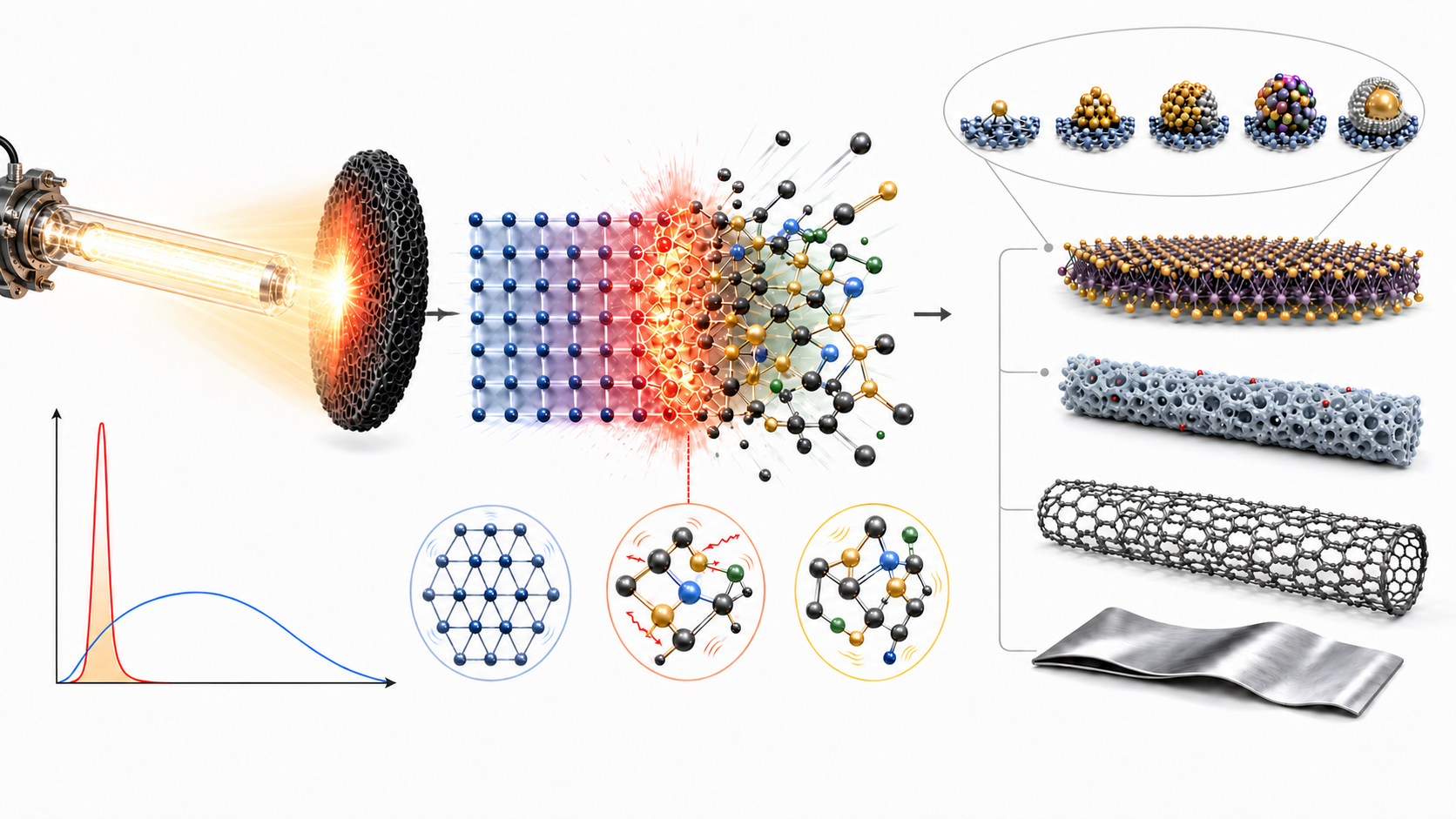
Conventional heating permits prolonged diffusion, sintering, and relaxation toward equilibrium. A rapid photothermal excursion followed by immediate cooling limits equilibration and kinetically traps functional nonequilibrium states.

Reaction kineticsk ∝ exp(−Ea / RT)
01Activate

Ultrahigh temperature rapidly overcomes kinetic barriers.

02Limit transport

Short residence time suppresses prolonged diffusion and coarsening.

03Quench

Rapid cooling preserves metastable phases, interfaces, and atomic configurations.

Broadband intense pulsed light from a xenon flash lamp drives direct photothermal heating, rapid nonequilibrium annealing, non-radiative recombination and phonon scattering, followed by catalyst functionalization of TMDs, metal oxides, carbon materials, and metal foilsIntense pulsed lightDirect photothermal heatingTemperatureTimeUltrafast annealingRapid cooling → NonequilibriumFurnace annealingSlow cooling → EquilibriumNon-radiative recombination · Phonon scatteringCatalyst architecturesSACsNPsAlloysHEAsCore@shell NPsTMDsMetal oxidesCarbon materialsMetal foils
Photothermal treatments

Compatible substrates and supports for rapid light-driven thermal processing.

01TMDs

Few-layered TMDs · High-edge-to-volume TMD nanoflakes

TMCs

Metastable α-MoC · W₂C

02Metal oxides

TiO₂ · Co₃O₄ · WO₃ · SnO₂ · In₂O₃ · etc.

03Carbon materials

Graphene oxide · Graphene quantum dots · Carbon nanotubes · Carbon nanofibers · etc.

04Metal foils

Zn · Cu · Al

One platform · diverse catalystsSACsNPsAlloysHEAsCore@shell NPs

Publication artwork

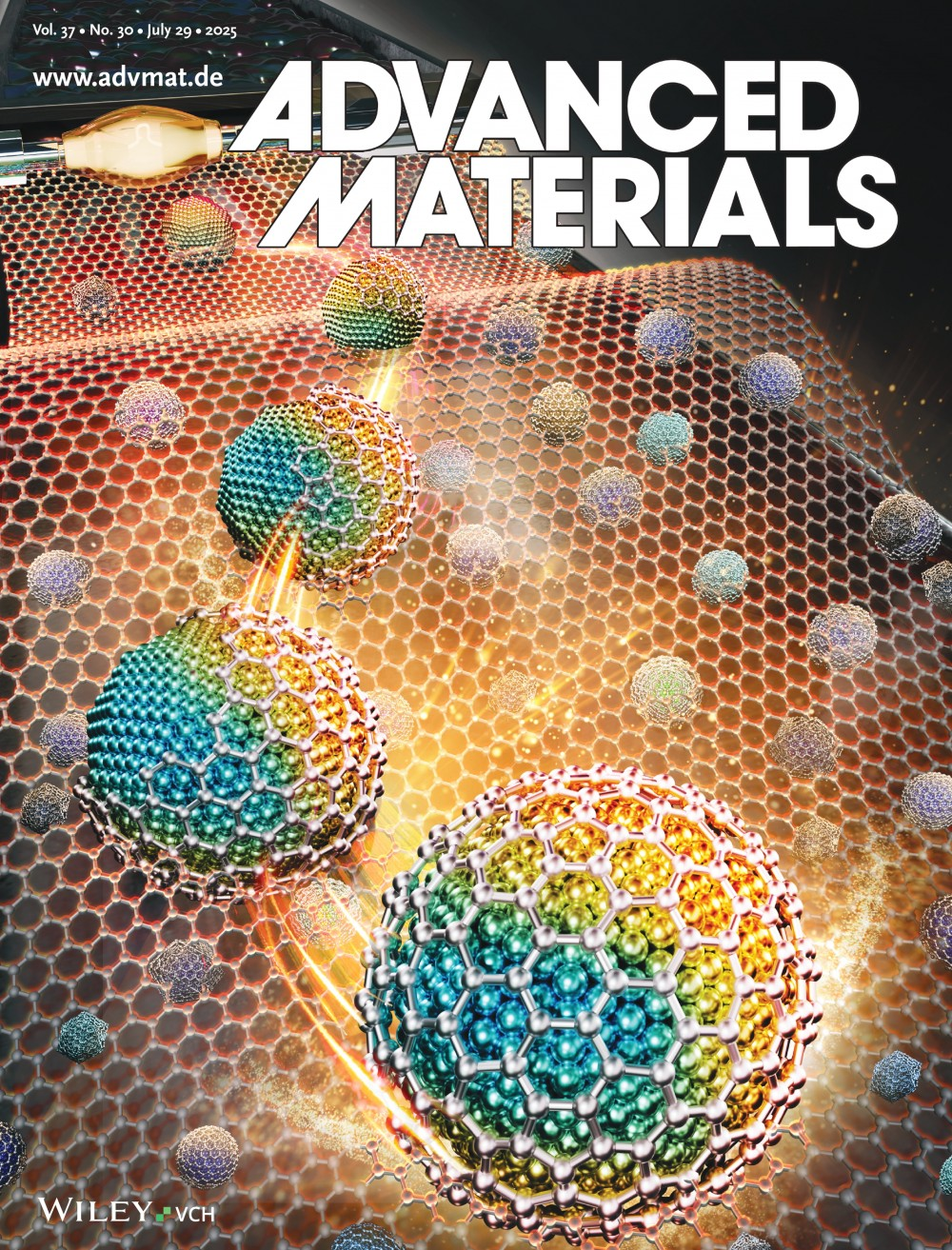
Journal Covers

Cover-featured publications across materials synthesis, catalysis, and sensing.

01

Ultrafast Nonequilibrium Materials Synthesis

Intense pulsed light converts optical energy into a millisecond thermal excursion, enabling reactions and phase states that are difficult to retain during conventional furnace processing.

A · Figure 1a
Flash-Thermal-Shock Platform

Schematic diagram of the preparation of TMDs and TMCs by Intense pulsed light. A photothermal effect is induced immediately at GO, reaching up to 3162 K within 10 ms with a heating rate of 9.7 × 10⁵ K s⁻¹ and cooling rate of 2.3 × 10⁵ K s⁻¹, which are suitable for metastable nanomaterial synthesis.

B · Figure 1b
Metastable 1T TMD Formation

Phase-controlled TMD containing 2H phase and metastable 1T phase.

C · Figure 1d
Metastable Carbide Formation

Transition metal carbides through a carbothermic reaction of GO.

Metastable 1T TMDs

Millisecond heating followed by rapid cooling kinetically traps the metallic 1T phase in transition-metal dichalcogenides.

Carbothermic conversion

High-temperature reaction with graphene oxide forms metastable α-MoC and W₂C within the flash-thermal-shock window.

02

Catalyst Emergence and Atomic Redistribution

Short photothermal pulses drive dopant migration, nanoparticle exsolution, and atom-scale redistribution while limiting prolonged thermal coarsening.

01 · Published
Ultrafast Ambient-Air Exsolution

Schematic diagram of exsolved noble metals decoration on WO₃ nanofibers via intense-pulsed-light-derived momentary photothermal treatment.

02
In preparationThermal Atomization of NPs into SAs via a Sacrificial Carbon Matrix

Temperature-dependent nanoparticle decomposition and atomic redistribution on a metal-oxide nanofiber.

03
In preparationFlash-Thermal-Shock Atomization and Atomic Dispersion

Nanoparticle atomization followed by isolated-atom stabilization on a metal-oxide support, verified by electron microscopy.

Exsolution

A momentary photothermal treatment moves Pt, Rh, or Ir dopants from the WO₃ lattice to anchored surface nanoparticles and oxide–metal heterojunctions.

Atomization

Rapid heating redistributes supported nanoparticles into isolated atoms, followed by stabilization at metal-oxide surface sites.

03

Phase and Heterostructure Engineering

The transient temperature profile controls TMD phase conversion and shell growth around metal, oxide, carbide, and multielement cores.

Figure 2a–c
Temperature-Controlled MoS₂ and α-MoC Formation

a) Temperature profile of ATTM contained GO with irradiation energy of 10 J cm⁻². The GO:ATTM indicated the weight ratio between GO and ATTM. b,c) XRD patterns (b) TEM images (c) of Mo-based materials after FTS. The number X of FTS-X K denotes a photothermal temperature of FTS.

Figure 2d–f
Temperature-Controlled WS₂ and W₂C Formation

d) Temperature-curve of ATTT contained GO with irradiation energy of 25 J cm⁻². e,f) XRD patterns (e) and TEM images (f) of W-based materials after FTS.

Figure 3a
Core@TMD Shell Formation

Schematic illustration of synthesizing core@TMD shell heterostructured nanoparticles on rGO.

Figure 3b–e
Compositionally Diverse Core@TMD Heterostructures

TEM and elemental-mapping analysis demonstrate TMD shells formed around metal, oxide, and multielement nanoparticle cores.

1T–2H phase control

Photothermal temperature and reaction time regulate conversion between semiconducting 2H and metastable metallic 1T TMD structures.

Core@shell formation

Nucleation, TMD growth, epitaxial growth, and confinement produce core@TMD heterostructures with compositionally distinct cores and shells.

04

Surface-Reaction Engineering for Chemical Sensors

Light-assisted surface modification places catalytic and heterojunction sites on porous oxide nanofibers to control adsorption, charge transfer, and gas reaction pathways.

01
WO₃/SnO₂ Heterogeneous Oxide Nanofibers

WO₃/SnO₂ nanofiber surface engineering.

02
Au-Functionalized Anatase TiO₂ Nanofibers

Au nanoparticle-functionalized anatase TiO₂ nanofibers.

WO₃/SnO₂

Light-assisted processing integrates WO₃ and SnO₂ domains across oxide nanofibers to create compositionally distributed surface-reaction sites.

Au–TiO₂

Au nanoparticle functionalization of anatase TiO₂ nanofibers provides catalytic interfaces for light-activated formaldehyde sensing.

Publication record

Published articles and supplied PDFs

Browse the complete publication list with direct links to the supplied article files.

View all publications